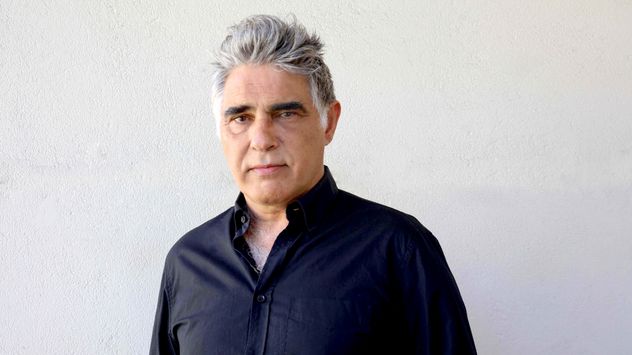
by Martin Kudlác
Portuguese underground filmmaker Edgar Pêra presented his latest work, Asphalt Guerrilla, at the 79th Locarno Film Festival. A regular presence at the Swiss festival, Pêra returned after showcasing Telepathic Letters there in 2024. While that film stages a fictional dialogue between Fernando Pessoa and H. P. Lovecraft through generative AI, Asphalt Guerrilla resists such a straightforward description.
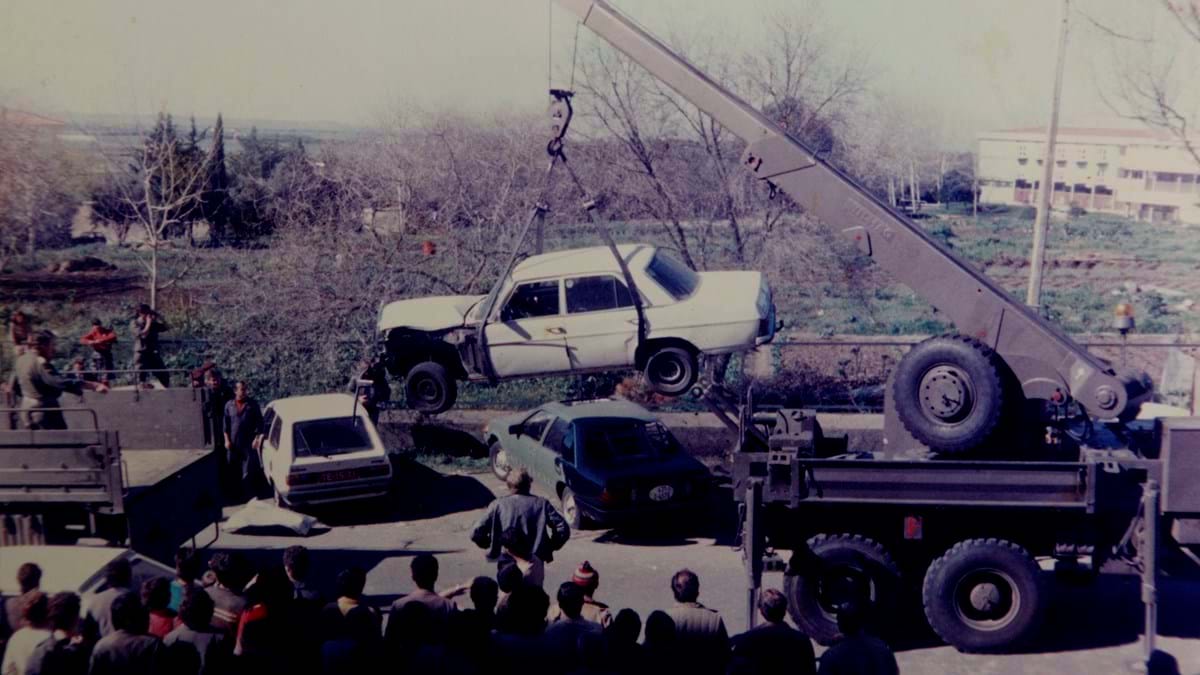
Billed as a hybrid documentary and “a real story based on surreal facts,” the film takes as its historical fulcrum a bank robbery carried out by FP-25, short for Forças Populares 25 de Abril. It also draws on the eponymous book by Manuel Ricardo de Sousa, a member of the militant organization who was lynched by a mob following the robbery, an incident depicted in the film.
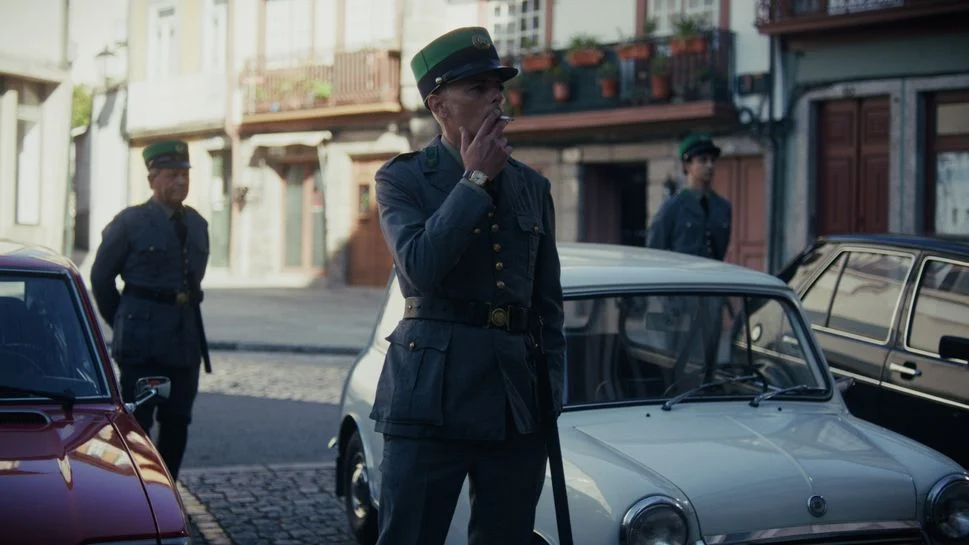
Historical reconstruction, however, constitutes only one layer of Asphalt Guerrilla (Guerrilha no Asfalto, Portugal, 2026). The film is part political manifesto, part autobiography and part documentary about FP-25 and the unresolved legacy of Portugal’s revolutionary period. It is also a meta-film about Pêra’s struggle to make cinema outside conventional production structures.
Asphalt Guerrilla is an unabashedly DIY undertaking, or an example of “punk filmmaking,” as Pêra calls it. It incorporates behind-the-scenes material from an abandoned, more commercial version of the project, whose studio-style production begins to resemble its own parody. Pêra combines staged scenes, archival and found footage, fragments of unfinished films and AI-generated imagery in a dense but purposeful stream-of-consciousness assemblage.
Through those collisions, the film connects the contemporary resurgence of fascism with ideas and images inherited from the counterculture of the 1990s. Among its central presences is psychedelic philosopher Terence McKenna, alongside archival appearances by writer and self-described “guerrilla ontologist” Robert Anton Wilson. Their once-futuristic ideas about reality, technology and political resistance now appear disconcertingly contemporary.
Desistfilm spoke with Pêra and producer Rodrigo Areias about the film’s troubled evolution, the unstable boundary between documentary and fiction, the political use of AI, Pêra’s countercultural archives and what he describes as the punk risk of being insulted.
Desistfilm: Asphalt Guerrilla is an interesting film. After Telepathic Letters, you still haven’t become bored with AI?
Edgar Pêra: Actually, I did get bored. I think the AI agents have almost all the fun and we are becoming tools for them. You write something, and then they have all the fun with it. I read that the most optimistic view of humanity after The Matrix is that we’ll be treated as dogs. That’s the best vision, they’ll give us things to do, “Go fetch”, because they will still need us for a while. At the same time, AI lets you build archives from the past and create parallel universes. The world was already being fictionalized, but now there are tools to make everything alive. Asphalt Guerrilla is not exactly about that, but it reflects it. In Telepathic Letters, people believed the images came from other films or from found footage. Even when I told them otherwise, they almost didn’t believe me. We are living in a surreal world where almost everything has the same factual value.
The film mixes very obvious AI with less obvious AI. What is the difference?
The non-obvious AI is the lie. It is when you deceive the spectator. The obvious AI is when you openly create with it. But AI has been present from quite early in the film, you are only told about it near the end. My producer Rodrigo Areias kept saying, “Don’t put too much AI in the first part, because it will spoil it.” We are working with the designer and musician Dada Garbeck, and when he started watching, there were very violent scenes he thought were AI. That is what happens once you know it is being used, you become suspicious. If you watch the film again, perhaps you start asking, “Is this real? Is this not real?”. Some of the old editing machines can give the game away, but people who never knew those machines do not have the same idea of what one should look like.
What about the found footage in which you appear? Was that generated?
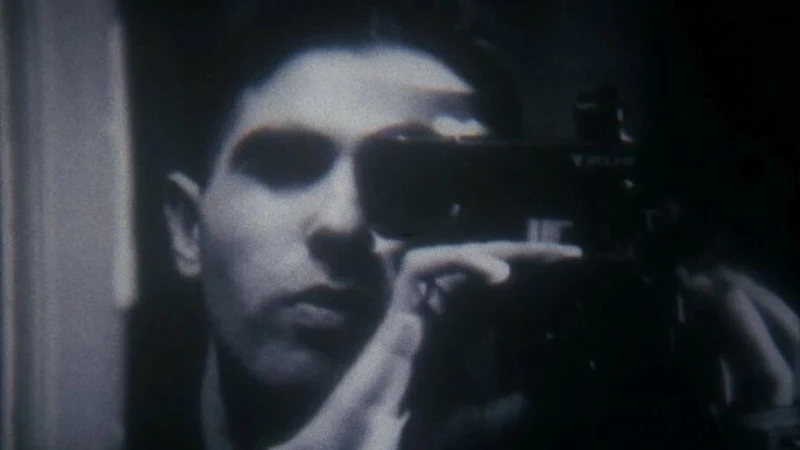
No. I can tell you that. But you shouldn’t ask too much, because then you will start guessing what is real and what is not. The film is based on our archives, 40 years of archives. The images from the 1990s were shot by me or by friends. Then there are places where it becomes a grey area.
It was surprising to see you become a character in your own film.
That was Rodrigo’s idea. I would never use myself as a character. When you edit, hearing your own voice and looking at your own image is not good for me. But Rodrigo made me understand that it was important. I didn’t want to go only into the past. I wanted to go into the future. We had to speak not just about politics, but about our politics. We started making one film and ended up making a film about the film we were making. The process took three or four years. We stopped, we fought, I didn’t want to make that film, and then we decided what it had to become. It was very organic. Rodrigo anticipates things I’m going to think. It saves me time.
How did you conceive something that keeps transforming, documentary, fiction, autobiography and finally something close to a manifesto?
It was a lot of ping-pong. I had been interested for decades in the story from the book on which we began, and I became too attached to it. Rodrigo compensated by bringing in other material, including material about me. I kept trying to put in less of myself and more of the political past. But if the film had only been about how the revolution died, the despair and the hangover of revolutions, it would not be the film it is now. Once we found the path, editing became easier, even if the final structure was found very recently.
Rodrigo Areias: The long conflict wasn’t between us. It was between Edgar and himself.
Edgar Pêra: It is difficult to make a film with yourself at the center. You need somebody outside to give you perspective. Rodrigo and I always collaborate, beginning with the conditions of production. What can we do with this? What is missing? What kind of film have we not made yet? We do not want to produce another algorithm of art.
Rodrigo, what changed at the production level?
Rodrigo Areias: We received money to make a film, started making it and then gave it up. That is the truth. We stopped that film and decided to tell the story of why we stopped. In a way, the film explains itself. The opening belongs to the movie we were originally supposed to make, the more commercial movie that existed on the page. We shot a lot of it and stopped. Then Edgar went deep into the archive. You dig a hole and go deeper and deeper, he began shooting new material to complement things from before. It became a matryoshka, an onion film. You keep peeling and never reach the core. It is better to talk about that process than pretend we can finally explain why.
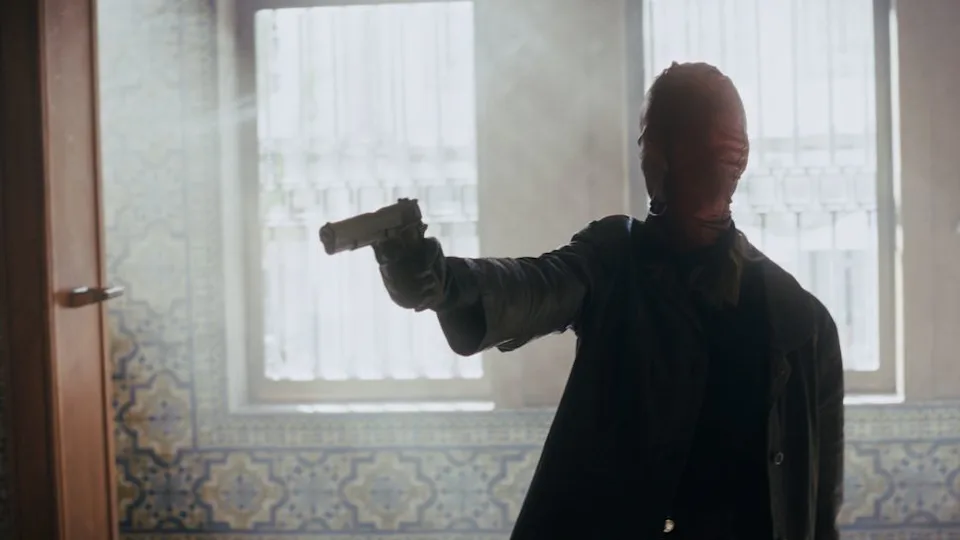
The “commercial” footage plays almost like parody.
Edgar Pêra: It is parody. We already knew we were making a punk film, even when we shot what was written. The problem is always the distance between what exists on a page and what you want to make. We knew we were getting into trouble anyway, so let’s do it.
Terence McKenna appears in Asphalt Guerrilla. How did that footage enter the film?
I filmed Terence for Manual of Evasion LX94, which you can find online. Lisbon was European Capital of Culture in 1994, and I decided to give it some counterculture. Terence, Robert Anton Wilson and Rudy Rucker came to participate. There was a great deal of footage, and I always felt I needed to do much more with Terence than I had done before. What he says is so contemporary that when we began discussing old footage, his presence became almost inevitable.
The ending feels personal, almost like closure for the film you and Terence never fully made.
It is closure, but also a great opening. People now come to me and say, “I didn’t know this guy.” That is important to make people aware of his presence, his thoughts and his way of living.
You also made Who Is the Master Who Makes the Grass Green? (1996) with Robert Anton Wilson’s voice.
Yes. It is a seven-minute film. Bob appears only at the end. There is much more unpublished material from those days. We could make a television series with many episodes. I don’t know if we will, but we should do something with it.
In Asphalt Guerrilla, though, the emphasis is on McKenna rather than Wilson. Why?
I had a very strong personal relationship with Terence while he was in Lisbon. He was supposed to stay for five days and stayed for ten. They were ten very intense days, and we formed a strong connection. Afterwards we kept emailing. He would say, “Let’s plot and scheme some revolution,” or something like that. We also made Zombie Town 23 for Expo ’98, which became the basis of the Anti-Zombie Manifesto. We were always trying to continue our fights, and then he died. That 26-year gap is something I wanted to show. I worried that there might be too much Terence in the film. Rodrigo said, “No, he is really important to you.” He is also important to the planet, because his thought becomes more contemporary as time passes. I knew Wilson’s writing much better when they first arrived. I had read The Illuminatus! books, The Schrödinger’s Cat trilogy, Quantum Psychology and Cosmic Trigger trilogy. But with Bob it remained more intellectual. With Terence, we were immediately asking what we were going to do next.
What originally drew you to McKenna? Was it the Timewave theory?
At the time I had only read Food of the Gods. I knew much more of Robert Anton Wilson as a writer. But Manual of Evasion (Manual de Evasão, 1994) is a film about time, so I was interested in Terence’s idea of time as something biological rather than mechanical. The best thing about Terence was that he was always suspicious of himself. He was not dogmatic. His theories were hypotheses, and it did not matter whether they were fiction or reality, because you always learned from him. He could find words from I don’t know where and speak as if he were writing. Even an ordinary lunch became a moment of transcendence.
You have said those ten days felt much longer.
When he died, I was sad as if a close friend from high school had died. Those ten days expanded. If time is biological, they were 100 days. I spent more than a decade listening back to him. My director’s cuts are usually shorter, not longer. It is like the line attributed to Blaise Pascal “sorry for the long letter, but I didn’t have time to write a shorter one”.
Are you planning to organize the rest of the McKenna archive?
Yes. I have been in contact with his brother, Dennis McKenna. I want to organize and digitize the tapes, share them with his family and make something available to everyone. Unfortunately, his analysis feels even more accurate now than in the 1990s. “We must live as if the apocalypse has already happened” is much more in sync with the present. Even images in the film evoke the destruction we see in recent wars.
The recent biography Strange Attractor includes you and images from Manual of Evasion. Did you read it?
I read my parts. I am quoted many times, and there are photographs from Manual of Evasion. I wanted to put one of the lunch clips online because it shows not the mythology around Terence, but how at ease he was with us, everyone together, almost like a party. That is how I sometimes like to shoot. In Portugal, people can become annoyed when they see that I am enjoying the work. For some people, what is sacred cannot be enjoyed. I am not saying cinema is not sacred, but it is not that kind of religion. It is not a dogma. Cinema is life, so it should reflect life. My films are not realistic, but I think they are alive.
How much fiction is in Asphalt Guerrilla?
I cannot tell you what is true and what is fiction. It is not exactly mystification. It is always rooted in real, or surreal, facts. Sometimes it is an extrapolation of what could have happened, sometimes it happened. But the roots are in reality. If I want to share the Philip K. Dick feeling that we are all living inside fake realities, I should not explain too much. As soon as I tell you one element is real, you decide the next one is unreal. I want that tally to remain unstable.
Telepathic Letters was more homogeneous, while Asphalt Guerrilla keeps changing form.
Yes, completely different. I like not repeating myself. But Telepathic Letters is also fake found footage, invented found footage. At the premiere, one woman asked whether we had secured the rights to all the films we used. She believed Fernando Pessoa and H. P. Lovecraft had really been filmed talking. In Asphalt Guerrilla, AI is used more politically. It shares this sensation that we are beginning to live inside some kind of Matrix.
Will you continue using AI?
Yes. One of our next projects is based on The Horror at Red Hook, one of Lovecraft’s most xenophobic stories. I want to turn it upside down. We will shoot footage, but also use deepfakes to create that mixed sensation of what is real and what is not, and to look at how the alt-right uses monsters to intensify xenophobic feelings. It is very political. I asked Gemini for an opinion of the script. It said, “Great idea. Lovecraft wouldn’t like it at all, but it’s a great idea.” Of course, they always compliment you. But it understood that the story was being reversed.
Do you believe Lovecraft would still write the same xenophobic story today?
No. From what I know, his actions could be more generous and open than his very old, bigoted frame of mind. He married a Jewish woman, for example. The cultural difference seemed to disturb him as much as ethnicity. I want to explore what makes that feeling grow, to make him perform a kind of update.
Alan Moore did a comics about Lovecraft´s mythos, Providence, and he fully understood what is beneath Lovecraft’s text and the things Lovecraft may have been horrified to find in himself. Moore did not write pastiche. August Derleth and others imposed a conflict between good and evil, but that is not what most Lovecraft stories are about. The Elder Gods do not think in human moral terms.
You explored related territory in Kinorama.
Kinorama (Kinorama – Cinema Fora de Órbita, 2021) was a 3D film that premiered online at Rotterdam during the pandemic, so it did not have much of a life. It includes Lovecraft quotations and an interview with the preeminent scholar on Lovecraft, S. T. Joshi. He was very funny. He did not know Moore’s adaptations, but he knew Moore was deeply involved and understood the scholarship behind them. Telepathic Letters is another iteration of that earlier work. It even uses the same voice actor, Keith Esher Davis, who died before the film’s premiere. I see connections among all these projects. Philip K. Dick is always there too, although I have never adapted him directly. That is more difficult.
Why is Philip K. Dick so central for you?
He is more present in our world than almost any other writer. Do you know his essay The Android and the Human? He writes about turning off the televisions that spy on you so that you can spy on the people spying through the television. He explains fake reality and the repetition of errors as android behavior.
But he was extremely paranoid.
Paranoid is one word for being aware of everything. Sometimes things do not exist, sometimes they are things other people cannot see, at least not yet. His paranoia may also have come from taking too many things to keep himself awake. For me, his importance is not that he predicted the future. He felt what was already happening and reflected on it.
Are you now making on a television series?
Yes, 13 episodes, 25 minutes each, about Portuguese hip-hop groups in the 1990s, particularly musicians from poor neighborhoods on the south bank of the Tagus, opposite Lisbon. I have footage from 1999 of one group playing before and then improvising with The Last Poets. That material has been waiting for more than 25 years.
What are the other projects in development?
There is a short film mixing animation, AI, 16mm and other media, again involving Lovecraft and Pessoa. It is not simply a continuation of Telepathic Letters, it is freer, almost as if they really met. Then there is The Spiral of Fear based on the Lovecraft story. We are still looking for financing. I have carried the project for around 20 years, and when something takes too long, you can lose the energy. Rodrigo and I try to think at least five years ahead. If you only ask, “What am I going to do next?” you are doomed. We already received development money for the screenplay, so at least I was paid to write, which often does not happen. Most of the time, actually.
Why does a larger production make you nervous?
When you see Asphalt Guerrilla, you understand that I am at ease with a Bolex, Super 8 or a tiny camera. I made a film for cine-concerts with the Portuguese band Dead Combo. Sometimes nobody was behind me because the crew were also the actors. It became a one-person crew, while everybody else dressed as Indigenous Americans or cowboys and had fun, too much fun for some people. We performed live. I would shoot in the city one day before a concert, put the tape into the computer at night, edit it, and then mix it with the live camera and other images during the show. It was freestyle, a punk method. Punk may not be the perfect word, you could say Dada. But punk is the word people understand for taking the risk of being insulted.
What is the best insult one of your films has received?
Someone wrote: “I had never seen a film by Edgar Pêra, and I hope I never see another one.” That was after CineSapiens (2013), part of a set of three 3D films, one by Peter Greenaway, one by Jean-Luc Godard and one by me. I was trapped between people who loved Greenaway and hated Godard, people who loved Godard and hated Greenaway, and everyone asking, “Who the fuck is Edgar Pêra?”
Does hostility bother you?
When you make many enemies, you also make a few new friends, and they are the important ones. Even if there are fewer of them, it does not matter. You find people in sync with your thoughts because you were not afraid to expose them. I later understood that CineSapiens was an insult to some cinephiles because I made jokes about the origins of cinema. It was part of my doctoral work, together with The Spectator’s DSM. It became the most polemical film I made this century, although that was not my intention. Other films were more deliberately political. Here, critics became outraged by the ideas.
So outrage can be useful?
If you know art history, why should you worry? Being attacked is almost a guarantee that you are not comfortably inside the system. Dada was not recognized at the time, now it is. To be recognized, you often have to be an outcast somewhere, at some point. I bought a biography of Hawkwind, and the beginning consisted of all the terrible reviews they received. I call those medals of war. The critics who wrote them might now be ashamed that they did not recognize the potential. I dislike attacks that become personal. But when someone is civilized and genuinely outraged by an idea, that is proof of life. It is not always good for obtaining money, of course.
What do you think is being lost as professional film criticism contracts?
Perspective. Newspapers and magazines carry less and less criticism. In Portugal there is a quarterly magazine called Argumento, where I have worked for around 15 years. Reader comments and lists are not enough for cinema. Even when I disagree with critics, I prefer to encounter thought. We also need more books about cinema. We need the written word, even if it now appears on a screen rather than on paper. I miss critics from the 1990s, including those who gave me the worst ratings, because they still tried to understand. They might not have been in sync with the work, but they went into it.
What, then, is the ideal critical response?
I like criticism that makes another film out of my film. The critic makes their own film. That means the original has enough freedom inside it to allow another perspective. Sometimes somebody sees something I never saw, and once they say it, I think: “Okay, that is valid.” That is the kind of spectator we must keep alive.
We have mentioned many shared reference points, but not Alejandro Jodorowsky.
I am not an expert, but the career prize I value most was the Prix Pasolini. Do you know who received it with me? Jodorowsky and Fernando Arrabal. I met them, and I still become emotional thinking about it. It was a prize for artists, created by artists connected to the Panic movement. The prize itself was a lithograph: a man onstage fanning the flames while the audience and chairs burned. I thought, “That is really nice,” because I sometimes feel my films set people on fire.
Would you call Jodorowsky an influence?
I saw many of his films later, so not in the same way as Fellini, Fritz Lang, Jacques Tourneur or Dziga Vertov. Fellini mattered because you feel life. Orson Welles’s F for Fake is one of my favorite films. It blurs fiction and reality perfectly and creates a direct relationship with the spectator, “For the next hour, everything I say is true.” Then the film plays with the fact that you do not notice when the hour has passed.
Jodorowsky also made major comics with Moebius.
Of course. But the most important magazine for me was not Cahiers du cinema, it was Métal Hurlant, where Moebius and Jodorowsky contributed. Not only because of the comics, but because of the essays, manifestos and provocations. It was there that I first read the idea that, in the future, Spider-Man and George Bush would possess the same level of reality. That made me think, and I began a series for the newspaper O Independente called Fiction and Reality.
Guerrilha no Asfalto
Asphalt Guerrilla
Director: Edgar Pêra
Screenplay: Edgar Pêra, Rodrigo Areias
Based on the eponymous book Guerrilha no Asfalto by Manuel Ricardo de Sousa
Cinematography: Jorge Quintela
Editing: João Mora
Sound: Pedro Marinho
Sound design: Pedro Góis
Sound mixing: Pedro Góis
Musi: The Legendary Tigerman
Art director: Ricardo Preto
Costume design: Susana Abreu
Hair/Make-up: Bárbara Brandão
Post-production: Maria Neto
Cast: Miguel Moreira, Maria Leite, Ivo Arroja, Albano Jerónimo, Bernardo Santo Tirso
Voice: Edgar Pêra, Albano Jerónimo
Producer: Rodrigo Areias
Production manager: Nuno Vassouras, Carlos André
Portugal, 2026, 77 min