by Libertad Gills
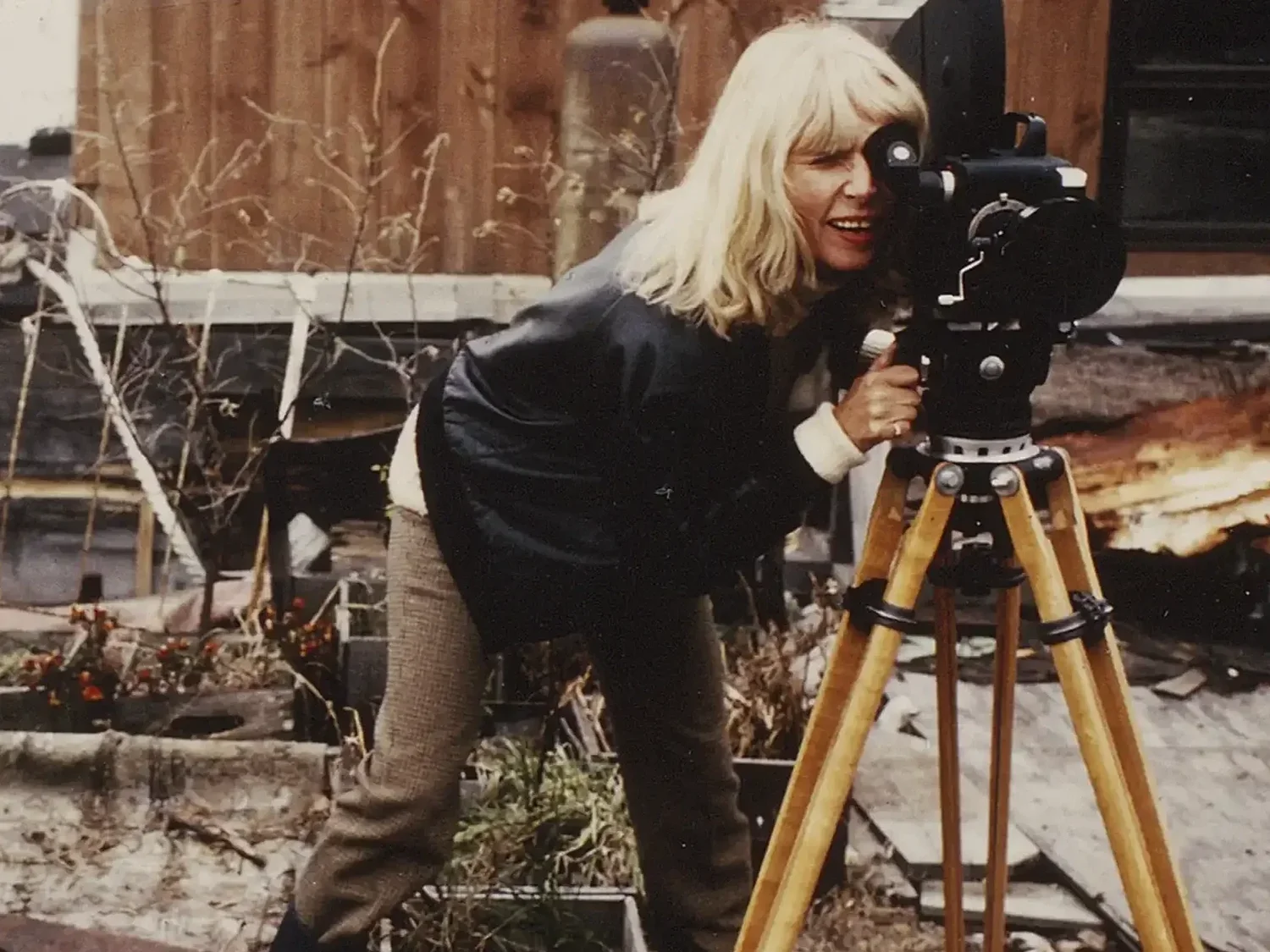
The Museo Hermann Hesse Montagnola, located in Ticino, Switzerland, is currently hosting an exhibition on the Swiss artist and filmmaker Isa Hesse-Rabinovitch (1917-2003), Hermann Hesse’s daughter-in-law who also illustrated many of his books. An established graphic artist, illustrator and self-taught photographer, she began making films in her 50s with her first short films Spieglei (1969), Monumento Moritat (1969), Julie from Ohio (1978), followed by her feature films Sirenen-Eiland (1981), Schlangenzauber (1984), and Geister und Gäste (1989).
Located at the top of the Museum, enclosed only by curtains, a small room is dedicated to her early 16mm color film Über einen Teppich (On a Tapestry, 1972), about the Liebespaar Il-Teppich (Lovers’ Tapestry) that hung in Hermann Hesse’s studio. The tapestry was made in 1932 by the Swiss textile artist and weaver Maria Geroe-Tobler (1895-1963), who lived across from him in Montagnola, and was close friends with Hesse and his wife, art historian Ninon Dolbin. So inspired was he by the tapestry, he published a text about it in the magazine Werk. Years later, and after his death in 1962, Isa Hesse transforms and translates the text into a film, using experimental shooting and editing techniques to convey the poetry and beauty of the tapestry, as well as the meaning and inspiration that Hesse attributes to it. Her hand-drawn storyboards for the film, which she used instead of a more traditional script, are also on display.
Hesse’s words, spoken by the German actor and one of the best-known audiobook narrators and speakers in German, Gert Westphal, express his admiration for the tapestry and his feeling of affinity with its creator. He feels, he says, like a collaborator or brother to the artisan. The tapestry, which has been made by hand over a year, is for Hesse a work of the most exquisite poetry, capable of making “the unimaginable imaginable”, and “the impossible possible”. He is fascinated by the imaginary space that the tapestry creates, one full of hidden images and messages, and connects it to the realm of myth, fable, and poetry, in which human beings, nature and animals peacefully coexist.
For Isa Hesse, the challenge is to make a film with only the tapestry and Hesse’s words. To begin, how to film a tapestry? It is still and silent. Therefore, she adds sound and movement. How to film a flat and horizontal object? How to give movement to something that is essentially still? And furthermore, how to capture the poetry that Hermann Hesse finds in the tapestry? How to create a film that will transmit to the viewer the meaning that he has attributed to it, and make it as inspiring to us as it was for him?
The tapestry has three layers, distributed horizontally across it, dominated by the colors red, blue, and red again. The film is also loosely divided in three parts, separated only by fades to white that provide a brief pause. At first we see the entire tapestry in a wide shot, but this is not the best way to see it for all its details and inner messages are lost. The camera immediately closes in on the colorful and expressive details, showing us the different characters depicted, including couples united in a loving embrace, trees and plants, and fantastical animals. Dissolves are employed to connect these images; zoom-ins and out at different speeds for emphasis, while pans reveal the intrinsic narration within the tapestry. Superimpositions and double exposures are used to create movement, where one of the images tilts down and moves up rapidly, as the other image below it remains still, creating a dynamic effect. When Hesse’s text describes the co-existence of black and white magic, the image is solarized and Hesse cuts rapidly between the nonsolarized and solarized images, as a visual representation of these two contrasting but coexisting forms; then when reflecting on lightness and darkness, she uses an iris and an inverted iris to bring light and shadow to the tapestry and cinematically illustrate these concepts. The tapestry is also filmed on a circular surface to add dimension to what would otherwise be flat. Together, these techniques demonstrate Isa Hesse’s experimental filmmaking and thinking around the question of how to film a tapestry.
The result is not only an incredibly skillful and beautifully made film but also a fascinating portrait of Hermann Hesse for it gives insight into how he saw the world and his craft. It is telling that he recognizes his craft in the tapestry and himself in the tapestry’s creator. The openness to imagine something beyond our immediate reality seems to be at the heart of his response to the tapestry -and at the heart of what makes him a poet. Some men, he says at the end of the film, will question the reality or plausibility of these images and their relation to the tangible world; they will question whether an elephant looks like this or a hyena looks like that. This kind of man, he says, will never understand the images in “my tapestry”. In other words, these men will never understand poetry. But when this man sleeps, Hesse adds, the images from the tapestry will come into his dreams and he will become an “involuntary poet”. But this is only temporary, he warns. And he is not a man, says Hesse, only a slave to his dreams and will forget them as soon as he wakes.
The idea that man must not be a slave to his dreams but rather find a way to dream awake, to allow dreams and what is possible in dreams to connect to man’s waking state and his way of seeing and experiencing the world, towards the pursuit of one’s inner self, is one of the key ideas expressed in Hesse’s writing. The fact that so many countries choose instead to live in states of perpetual war and violence, inventing absurd bureaucratic systems of control for the purpose of these wars, to which people abide blindly, is baffling to Hesse, as revealed in his short story written in first person, “If the War Continues” (1917). At the end of the story, the young man who has been away for some time and returns to a country in which war is a way of life and where you need a license-to-exist, as well as a death certificate to be allowed to die, decides that it is better to not participate in such a world. He writes, “…I spoke to the tiny blessed star within me, shut off my heartbeat, made my body disappear into the shadow of a bush, and continued my previous voyage without thinking about returning home ever again”. Hesse, for his part, exiled himself from Germany following WWI, was given Swiss citizenship in 1923, and made a home in the tranquil town of Montagnola where in addition to writing, he painted the Ticino landscapes that surrounded him (on display in the museum). Uber einen Teppich is a film about what is possible when we dream awake and when we allow our eyes to believe that things can actually be beautiful and good. In other words, it’s a film about a utopia which exists in a tapestry, and because it exists there, it ceases to be a utopia and becomes a reality.
As one of her first films, Über einen Teppich is also a reflection of the artist and filmmaker Isa Hesse and the themes that she will continue to explore in her subsequent films, including but not limited to, her collaboration with poets and poetry, an interest for esoteric imagery and in particular key motifs like the eyes and serpents (the latter explored in the photo-collage and 1984 film Schlangenzauber), and finally, her decision to work with or about women artists. In fact, after screening Über einen Teppich at the first Women’s Film Festival in New York in 1972, Isa Hesse returned to Switzerland and organized the country’s first women’s film festival in 1975, evidence of her dedication to creating spaces for the visibility of other women artists. It is important to note here that the film is made only one year after women were granted federal voting rights, making Switzerland one of the very last Western and European countries to do so. By making a film about the tapestry, she brings attention to the work of its weaver, Geroe-Tobler, with whom Hermann Hesse so closely identifies. Geroe-Tobler’s story is also a fascinating one: born in St. Gallen in 1895, she went to Bauhaus in 1928, where she received instruction from Wassily Kandinsky, Josef Albers, Paul Klee, and Oskar Schlemmer, and later joined Gunta Stölzl’s textile department, where she primarily worked on weaving. She became one of the most important representatives of contemporary textile art. She, Ninon Dolbin, and Hermann Hesse are all buried in Sant’Abbondio Cemetery in Gentilone, just outside Montagnola.
The tapestry hangs outside of the screening room in the museum, on the wall above the fireplace, as it once did in Hermann Hesse’s studio in Casa Comuzzi. The once bright red and blue colors have washed away with time and light, but the beauty within it remains. It’s strange how small it looks after you’ve seen its details in close-up in the film, or rather, how the film made it appear so much larger than it really is. Many people enter this room and do not notice it. But, perhaps, when these people return to their homes and fall asleep, they will dream and the images from the tapestry will suddenly appear…
Über einen Teppich (On a Tapestry, 1972)
16 mm, 10 min., color, German, English.
Camera: Ernst Bertschi. Carpet: Maria Gerö.
Text: Hermann Hesse, spoken by Gert Westphal.
Awards: Paris Art Film Festival 1972,
Swiss Film Week in London 1973,
1st Women’s Film Festival New York 1972, USA distribution.
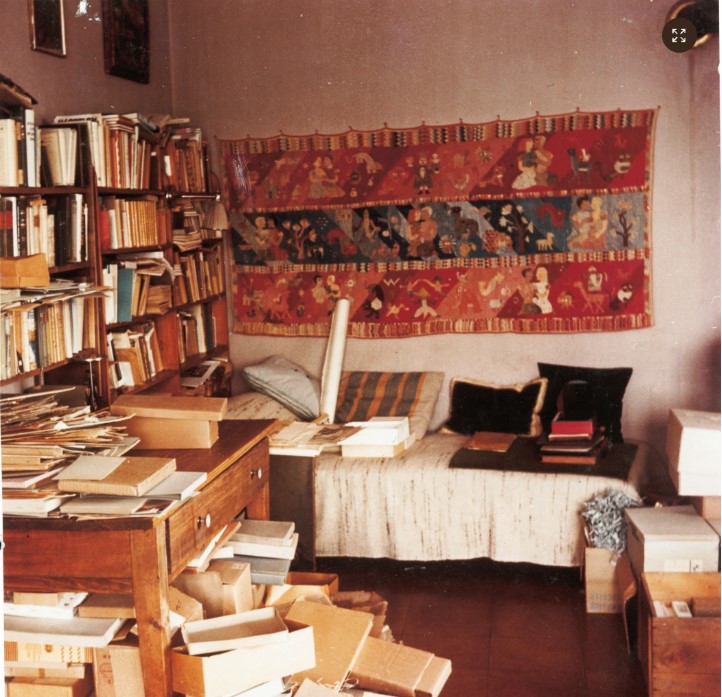
Photo: Hermann Hesse’s study, with the Lovers’ Carpet in the background. Image: Martin Hesse/Martin Hesse Heirs
Isa Hesse-Rabinovitch!
Museum Hermann Hesse Montagnola
March 28, 2026 – November 1st, 2026
Curated by Marcel Henry
For more on Isa Hesse’s work, including the recently restored Sirenen-Eiland (1981), see: https://www.filmexplorer.ch/detail/isa-hesse-rabinovitch-sirenen-eiland/