
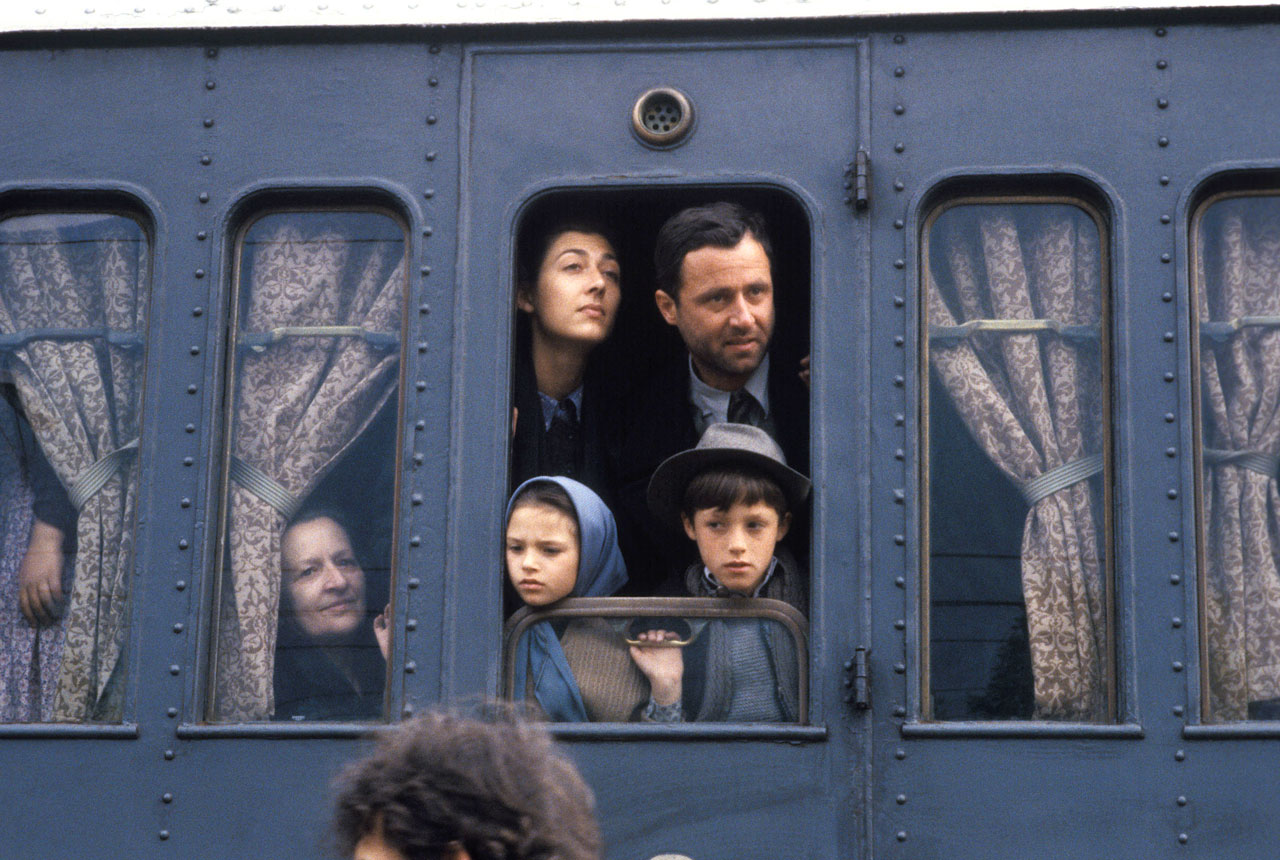
by Claudia Siefen-Leitich
In March 1938, westerly winds sweep across Central Europe during the night, and light precipitation falls in the Northern Alps. The weather is mild despite variable cloud cover, and quite sunny in the east and south. The first rain showers are already falling in the west, and a strong wind is blowing in open areas. The Alpine foothills, however, are spared from frost, and in the mountain valleys it is only moderate in the morning. The gentle morning sun falls on the stone of the old houses; the sky shines blue against the grey-white walls and the brown and black roofs, whilst the street sweeper pushes his cart along with a clatter of gravel. Shovels, brooms and rakes are within easy reach, but Dario (Martin Abram) takes his time. His dog runs alongside him, sometimes behind him, sometimes in front of him, scratching as he buries his nose here and there in the soft earth by the side of the path. Children’s singing can be heard from the school whilst Dario scrapes up the dung and dirt. The atmosphere is almost like a Sunday. Almost.
What constitutes the wealth, power and richness of a life, and how is it determined? Looking back only ever at history, may we proudly admit that we are poor citizens? It is plain to see: the garment, now worn down to the very last thread, was not tailored to the figure; and beneath its tatters already appears a wilder, more innocent nature than that whose sounds once made the curtain tremble, behind which time still concealed the great spectacle of democracy. Wherever thought is deepest and boldest, feeling most vivid, and the blow most relentless, the revolt against established values is unmistakable. Yet never are those bearing direct responsibility more isolated, nor their work more endangered, than here. The hero’s development is sparsely nourished, for roots must reach deep through barren soil to reach those springs which form a unity of intellect and spirit.
The girls in their school desks wear their plaits wound round their heads, or they fall loosely onto their shoulders. The teacher in his uniform criticises the children’s poor Italian; it results in slaps. The thud against the delicate fabric of the ear, a hard, brief pressure on the cartilage. What does such a casual blow do to a child, as if it were no big deal? Here we are amongst the barbarians, and violence is a yearning for order. The sky is so blue and the benches in front of the houses are green. With long, lingering shots (film editing by Daniela Padalewski), the landscape appears gentle, whilst the scraping of the broom penetrates the classroom. What a tumult of rhythms, a interplay of languages: ‘Well, who am I, then, if I only speak Italian? This is South Tyrol, after all, not Italy.’ They drink ‘red fire wine, the enemy’s blood…’, and the Rabensteiner family has quickly become the Pietracorvo family. Does language not also define a person? Already, son Alfons ends up in the latrine out of childish desires for revenge.
Here, the doors provide the backdrop to everything that happens. The view of the meadows or a glimpse of the slightly overcast sky; the sight of half-set dinner tables and walls decorated with pictures (lighting: Harald Wurmbrand). Do people actually take out loans from an Italian bank? And love, too – as Ettore, the Italian policeman, says: ‘I learnt German for you, Anna.’ Only to shout all the louder: ‘Hitler’s in Austria! He was on the train, but he didn’t stop!’ And at school there are presents; the well-behaved children wear uniforms and are handed warm socks and a book, The Adventures of Pinocchio, whilst the others look on in dismay. But the teacher has made a joke, and now all the children are being given presents. If you divide the impending crime into a thousand parts, it becomes anonymous. Anna and Ettore get married; someone else delivers the post. They sing the song ‘La Montanara’:
Blau strahlt da das Firmament
Von Ferne rauscht ein Wasserfall
Und durch die grünen Tannen
Bricht silbern das Licht
Doch meine Sehnsucht brennt
Im Klang alter Lieder
Laut hallt mein Echo wieder
Nur du hörst es nicht.
(The sky shines blue / A waterfall roars in the distance / And through the green fir trees / The light breaks through, silvery / Yet my longing burns / In the sound of old songs / My echo resounds loudly / Only you cannot hear it.)
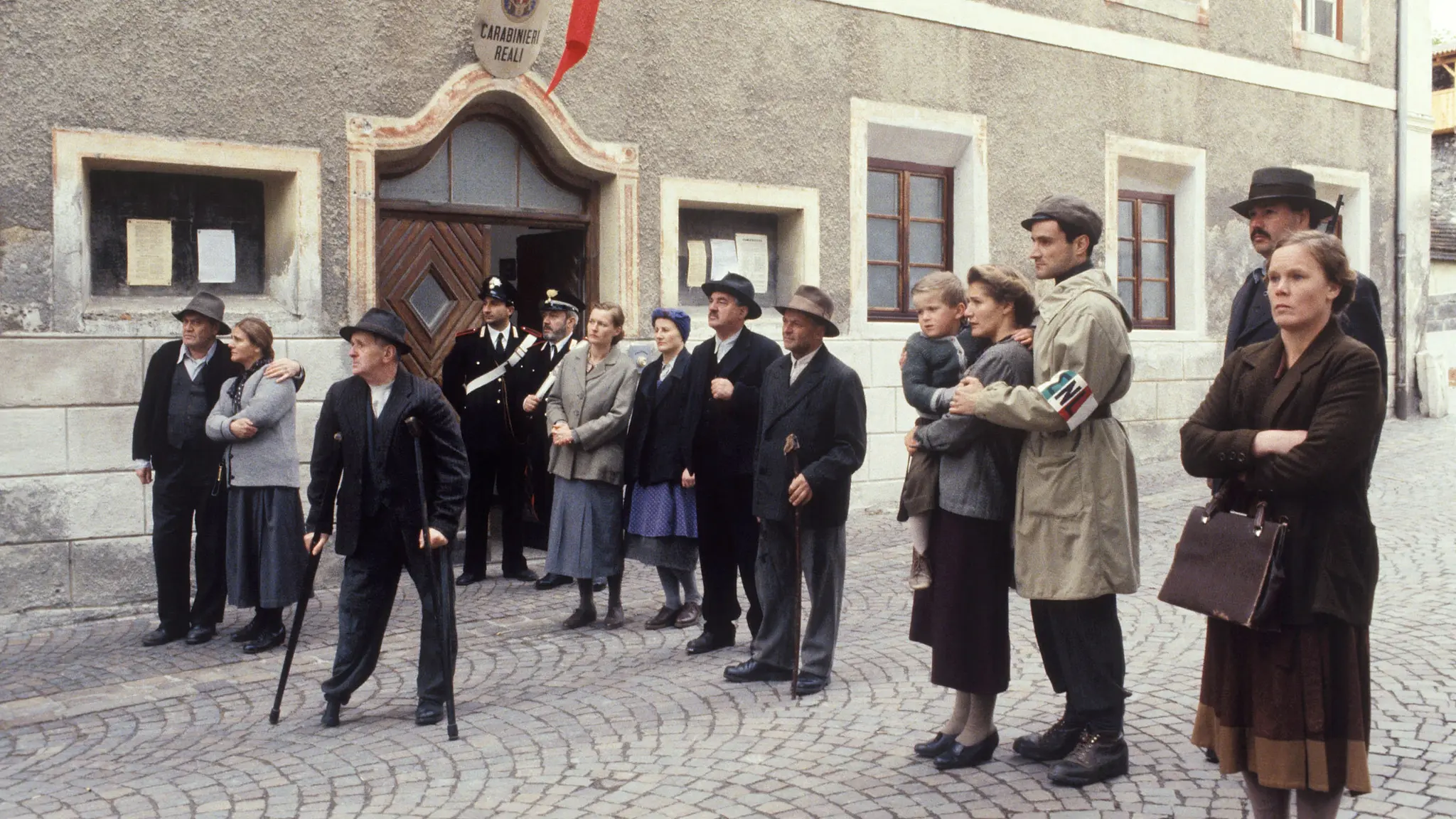
In July 1939, the motto becomes ‘Blood or Land’ – and we’ll certainly give you that land! Friends are beaten up; they’re found at night in the quiet alleyways. There are two forms: the red one for those wishing to emigrate, and the white one for those who want to stay at home. People are supposed to leave; apparently there are 20,000 farms in Sicily. The camera (Helmut Pirnat) shows the top and the bottom, right and wrong, and how difficult it is to make up one’s mind. The chosen camera angle is simple and explanatory: the stairways in front of the houses create a sense of perspective. Nobody wants to leave, for there is war out there after all. In the village, you can already hear the gunfire; there are blows, and even fires. The marching will begin, for all rhythmic things are merely weapons against time, and it is against time that man fundamentally fights. Man is always fighting against the power of time. Yet the New Year begins with a different song: ‘… above all in the world’…
In March 1940, they set off; they’d packed their household goods, the few suitcases they had, with a horse pulling a cart, whilst Dario watched it all, and his dog watched his master do the same. They’d cried, they’d been beaten, but it was all to no avail. Someone is always left behind. There are now six children in the school class. And Ettore remembers how, as a child, he used to tend sheep, always with books hidden in his pocket. He would lie in the meadow and read. When his father noticed this one day, he took the books from him and burnt them in the stove: ‘You’ll soon stop understanding the sheep!’ Germany needs even more labour; the strength of the South Tyroleans brings both strength and joy. If only that were the case – but where is that joy supposed to come from? The camera frame grows ever tighter and more static; the actors are literally deprived of the space to move freely.
Their little son Andrea is born, and Dario continues to sweep the streets, which are becoming ever emptier, accompanied by his dog. Houses and farmyards lie in the shadow of the mountains; the doors are left unlocked, and, increasingly, a composed, ethereal piece of music hangs over everything. When one is conscripted into the war, one is stripped of one’s autonomy. A small Italian family now lives in the house, and someone asks the father: ‘Why did they leave?’ ‘Because they’re Germans.’ And he slaps his forehead: ‘I can’t stand this for long; the mountains are closing in on me.’ Along with the threats and the sleepless nights comes the realisation that one has been betrayed. But those who have to go to war head for Innsbruck. The children carry on hurling insults at one another, repeating what they’ve seen and heard from their parents. Then, in July 1943, Pietro Badoglio takes over. What on earth is going to happen to everyone, and why must one always just let things happen to oneself?!
Hermann Tschurtschentaler wants to go to war, for he has a homeland once more. Those who work should also own property. One then defends that property, and that is simply how war comes about. Already his frail bones are trembling … South Tyrol is free when Ettore is beaten up. For times, they are changing. And they’re changing fast, Father: ‘A few of you are already on your way to Dachau!’ Kathi Rabensteiner – that’s her name again – returns from Germany. The family lived in Essen, but that would be a completely different story. And Ettore has to go into hiding; he heads north, to Belluno, to join the partisans. The fighting just never ends. How does one feel when one shoots someone? Killing is not an inner struggle – the maiming, the screaming, the death throes of the animals in the burning barns. Man is encroaching on nature: ‘I’m a farmer, after all, not a soldier!’
It is May 1945, and the victors now look different: they are ‘Negroes’, ‘Welsch’ and ‘Jews’. Dario is still sweeping the streets, and Toni has finally bought the farm. But dreams look different now. One is a journalist and might one day go into politics. Passing on the farm will prove difficult. The option agreement has become worthless, and one no longer knows what to make of one’s worldview. Roots must reach deep through parched soil to reach those springs that form a unity of intellect and spirit. ‘What is to come and everything that happens lies with us all,’ says Hermann Tschurtschentaler, stirring his soup calmly.
(My text refers to two films by the Austrian director Karin Brandauer (1945-1992), Brennende Lieb’/Burning Love (1989) and Leb’ wohl du mein Südtirol/Farewell, My South Tyrol (1989). Brandauer co-wrote and directed two episodes of a four-part miniseries about the post-war effect of Mussolini’s sham 1939 referendum regarding Austria’s truncated South Tyrol province, which the Allies had ceded to Italy following the First World War. The German version of my text was published with the Filmarchive Austria book series ‘Edition Film Geschichte Österreich’, No. 04; Vienna 2018; edited by Florian Widegger.)