By Ivonne Sheen*
In their essay Waiting for Resurrection[1], the Syrian anonymous collective Abounaddara rethinks image-making from the perspective of the land they come from, its geopolitical changes and their ancestral mythologies. These aspects, such as memory as a ruin that the new generations carry or the tension around images as receptacles of the Sacred or as merely prototypes of the Sacred, resonate very much with the films that shape the After the image is the present program. I take some of the reflections by the film collective to trace a river crossing the films in order to dive deeper into their intentions and resonances.
The selection focuses on works that have been made or that address themes related to various histories of occupation and war, situated in what is now known as the SWANA[2] region. The program offers a starting point through performative actions that build statements and portray a state of things, mediated by the presence of a body immersed in a bigger-than-them reality which has turned into ruins and that are part of a constant cycle of destruction and dehumanization. It is in this constant repetition of disappearance and reconstruction that the concept of resurrection presented by the Abounaddara collective comes back to me, through which the film collective proposes cinema as a potential medium for focusing on a resurrection that moves beyond a nationalistic imagination of it, but focuses on the personal life experience as a core, to bring the invisible to the surface. The backwards movement in Get ready again (2011) by Andreas Savva, the first film of the program, somehow recalls this going back to the ruins to transform them, maybe with a dose of hope.

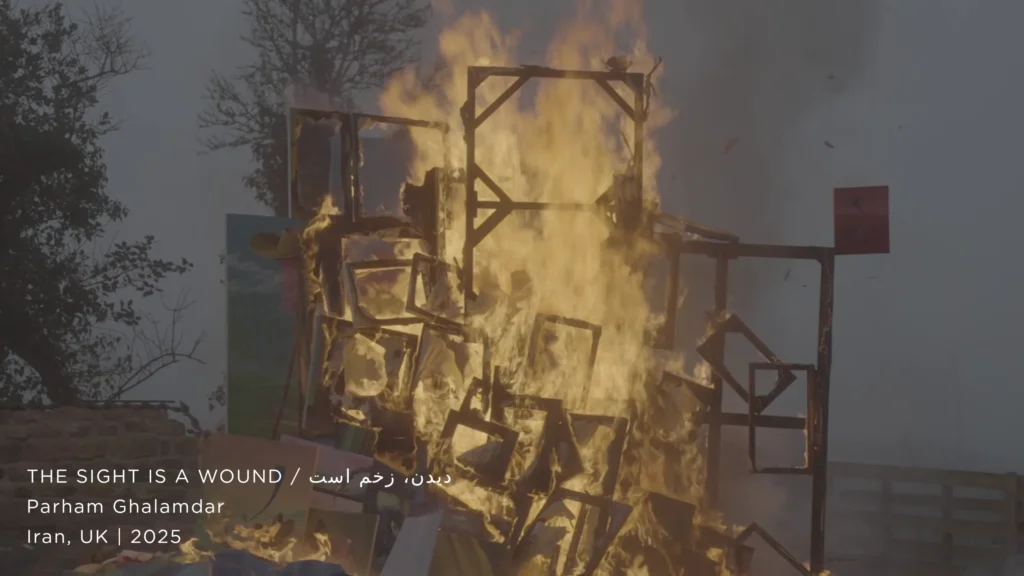
As for the concept of ruin, the collective proposes that “each generation finds itself at the same starting point: it inherits ruins to which it must add its own share, reluctantly.” What’s our share in a context of hyper-visuality and techno-fascism? In The sight is a wound (2025), the artist Parham Ghalamdar decides to sacrifice the most personal relationship to images he has: his own paintings. The action of self-destruction relates to the intention of transfiguration that Abounaddara proposes when they decided to film the ruins that they carry. The fire is an essential element for transformation and even though the act of destroying a personal invaluable object feels like a limit, and the voice-over of the film brings a pessimistic relationship to the hyper-visuality of the genocide of the Palestinian peoples, I still consider that the action of burning something is also a way of offering it, of giving something personal in memoriam of those who have unfairly been disappeared and as a way of believing in the sacredness of images beyond the visible.
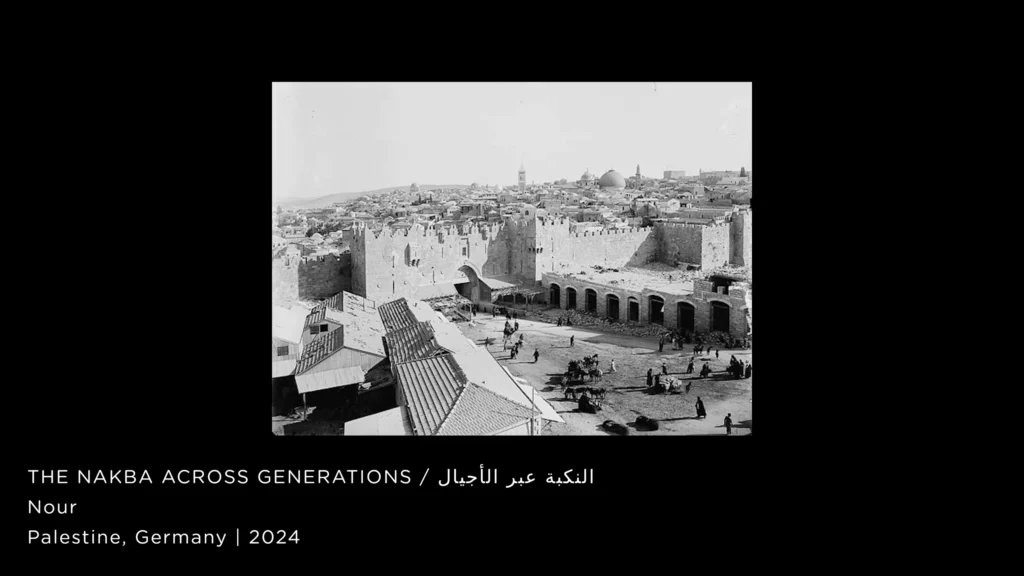
The silent presence and the inner thought of these political performative actions are complemented by the following films in the program which portray testimonies of the older generations, from whom the authors have inherited their ruins. In The Nakba across generations (2024) by Nour, different generations in intimate spaces and conversations reflect and remember together how a family has been affected by displacement, how their identities have been cracked, and how they had to emigrate to the countries that are also responsible for and accomplices in the occupation. The film only shows a few faces, protecting the identities of the interviewed, and bringing a common tension into the room that is quite present in every corner of the world. Who has the right to speak about the genocide and to be applauded?[3] At the same time, when just a few understand and listen to the testimonies of the past generations who are still alive carrying their own ruins.
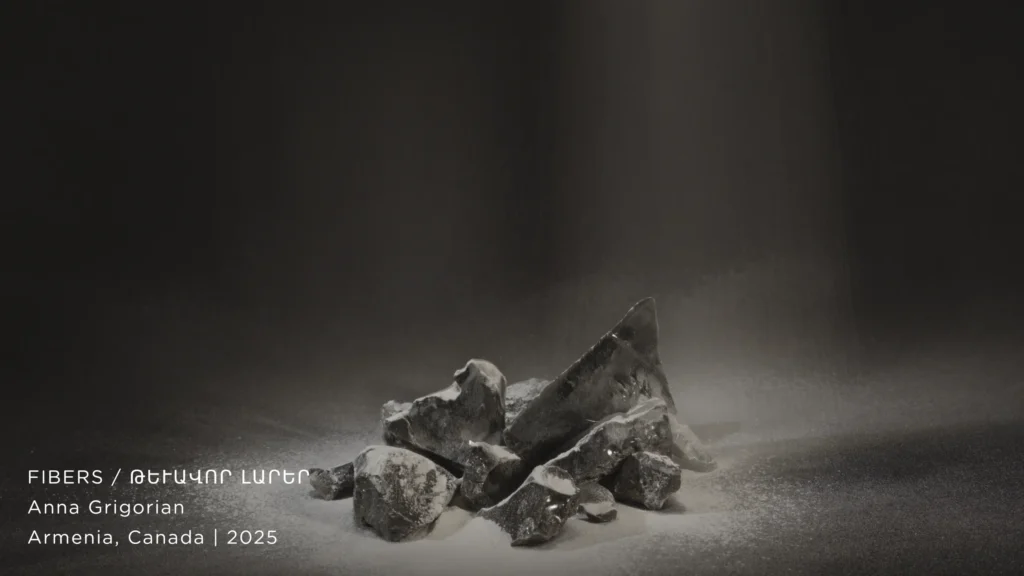
This exercise of listening and going back through the “human history” in Kapka Kassabova’s words[4], who also explains that history is mostly written by the ones who were not present “there”, is a form of resistance and commemoration of the survival of memory that fights for humanity in reaction to the imaginaries that oppose it. The act of listening and its evocations are woven in the film Fibers (2025) by Anna Grigorian, in which we see the making of the Armenian zhengyalov bread, we learn how to make it and we witness how these hands remember very well how it is made or it should be made. Following the instructions, a memory comes back and the persistence of joy and love overcome any fear. Love is stronger than fear and love gives meaning in times marked by a lack of sense and extreme violence. There are unspoken experiences embedded in this knowledge of bread-making, living on as ruins and brought back into the present every time someone makes this bread. Ancestral knowledge carries the souls of those who have witnessed its existence and have digested it.
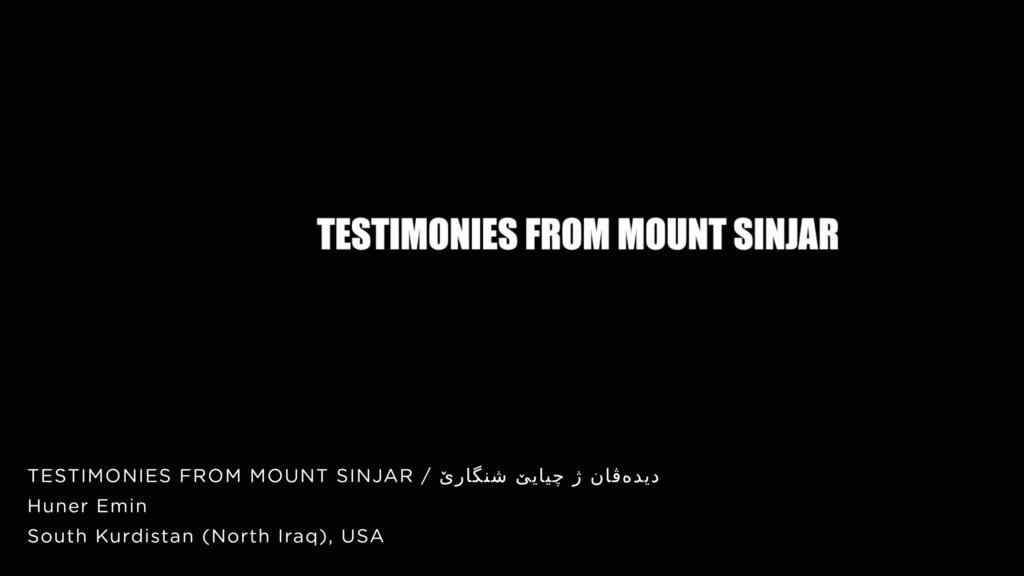
Coming back to the silent process of remembering and reacting, the lack of reproduced images connects to the impossibility for images to embrace the reality that they pretends to portray. The series of written testimonies in the format of the script in Testimonies from Mount Sinjar by Hunter Emin establishes a necessary agency from the spectator, since our own imagination is the one building mental images of the violence and displacement. It becomes an impossible film of an un-human reality. Would something change after witnessing once again the end of the world with images? The attention and agency are demanded in this film, so we are indirectly involved in what is happening or has happened. The image of Mount Sinjar as the origin of these testimonies recalls the struggle that the Yazidis people are constantly facing, who had to escape ISIS persecution and run away to Mount Sinjar to protect themselves.
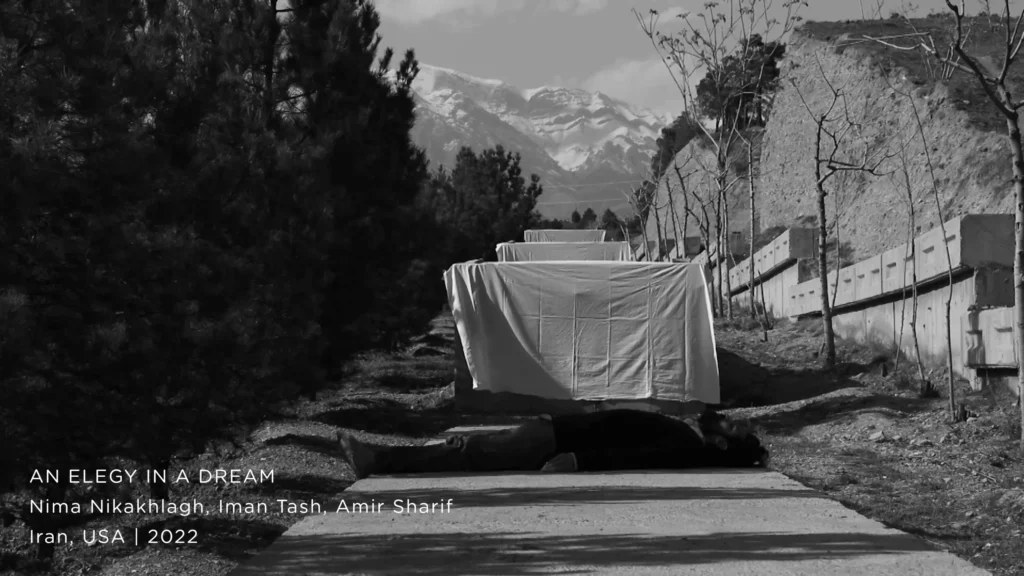
The closing film of the program, An elegy in a dream (2022) by Nima Nikakhlagh, opens a dreamlike portal, where words are not enough and experimentation makes it possible to open up pathways that form a labyrinth. Throughout the film, many images of a territory appear as a dreamlike journey which can hold different meanings for the people who have been there – coming back to Kassabova’s reflections – but also trigger the personal memory of those who cannot recognize the landscape. There’s a tone of nostalgia throughout the film, but I would like to describe it better as the final moment of the “resurrection” proposed by Abounaddara, in which the image results from a transfiguration that is moved by an intense desire for utopia.
Films
GET READY AGAIN by Andreas Savva | Cyprus | 2011 (02m20s). Silent, Color
THE SIGHT IS A WOUND by Parham Ghalamdar | Iran, UK | 2025 (06m48s). Sound, Color
THE NAKBA ACROSS GENERATIONS by Nour | Palestine, Germany | 2024 (11m). Sound, Color
FIBERS by Anna Grigorian | Armenia, Canada | 2025 (15m30s). Sound, Color
TESTIMONIES FROM MOUNT SINJAR by Huner Emin | South Kurdistan (North Iraq), USA (07m50s). Silent, Monochrome
AN ELEGY IN A DREAM by Nima Nikakhlagh, Iman Tash, Amir Sharif | Iran, USA | 2022 (18m36s).Sound, Monochrome
Notes
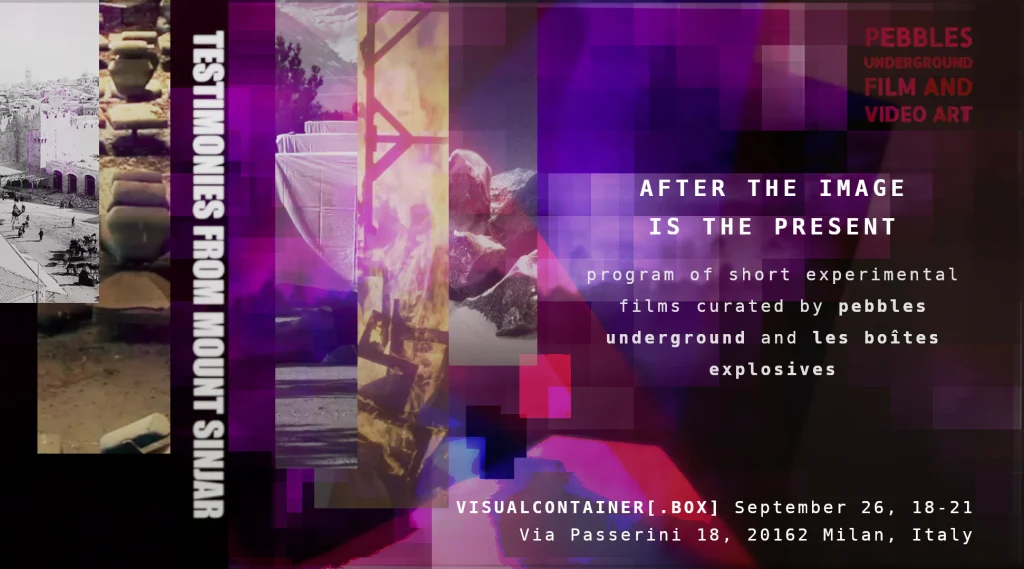
*This article was published at AFTER THE IMAGE IS THE PRESENT Program of experimental short films, curated by Pebbles Underground and Les Boîtes Explosives. Presented by Visualcontainer[.BOX]
[1] This essay is included in the booklet that accompanies Abounaddara’s first US solo exhibition at BAMPFA in October 2024, entitled The ruins we carry.
[2] South West Asia North Africa
[3] This question is a reference to the reflections addressed recently by Carolina Bracco about the 25 min obsession that the directors of the film NAZA received during the premier of their film in the recent Venice Film Festival. https://carolinabracco.substack.com/p/la-burbuja-de-naza
[4] These reflections are taken from the foreword written by the author for her book Border: a journey to the edge of Europe published in 2017.