Page 294

Staff

Film Festival Reports

TORINO FESTIVAL 2012: I.D. BY KAMAL K.M.

By Vassilis Economou

For the majority of the western audience, films from India are usually related with Bollywood themes, musicals, romantic comedies and silly action films. Fortunately there still exists a different way of filmmaking that will appeal to more eclectic tastes. I.D. is the debut film by the Indian director Kamal K.M. and it participated in the official competition of the 30th Torino Film Festival.

READ MORE »
Film Festival Reports

TORINO FESTIVAL 2012: MADE IS ASH BY IVETA GRÓFOVÁ

By Vassilis Economou

Slovak cinema has gained some acknowledgement during recent years, especially in festival circles. Až do Mesta Aš (Made in Ash) is participating in the official competition of the 30th Torino Film Festival. Torino is known for promoting new directors, and Iveta Grófová has made her debut with this feature film.

READ MORE »
Main Articles

SWIMMING IN A SEA OF IMAGE: ABOUT JAPANESE CINEMA IN 2012

By Daisuke Akasaka

In 2012, the Japanese cinema scene seems to be designed with a similar pattern to the past. While TV movie-series features, Japanimation and live-action movies from comics continue to be made and to be shown in the multiplexes, famous directors like Takeshi Kitano, Kiyoshi Kurosawa, Takashi Miike and Koji Wakamatsu continue to make their own films, and younger filmmakers are acclaimed in the international festival circuit, like Naomi Kawase, Nobuhiro Suwa, Hiroaki Koreeda, Shinji Aoyama, Sion Sono and recently the younger Katsuya Tomita (“Saudade”).

READ MORE »
Main Articles

FILMED RITUALS: ZERO JIGEN INCARNATES ON SCREEN

By Julian Ross

Gishiki (Oshima, 1971), translated to The Ceremony for its theatrical release in English-speaking countries, framed its narrative around traditional rituals practiced in Japanese culture. In Oshima’s film, these ceremonies marked occasions that brought together members of the central family who witness their family tree collapse as their stories unravel over the span of a lifetime. The word gishiki, the title of the film, was a term often used, by the news media and the artists themselves, for the activities of the Japanese avant-garde in the 1960s. Performance artists, dancers and filmmakers enjoyed ceremonial rituals as a remarkably unrestricted form of artistic expression. Hijikata Tatsumi and Ohno Kazuo’s Ankoku Butoh [Dance of Darkness] were described as rituals in early reviews, and their inaugural performance of Kinjiki [Forbidden Colour] in 1959, a dance interpretation of Mishima Yukio’s novel where a chicken was sacrificed, certainly evokes a liturgy from a bygone era.

READ MORE »
Main Articles

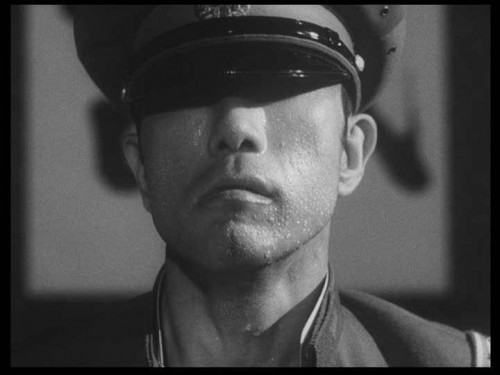
PATRIOTISM BY YUKIO MISHIMA

By Sarah Nichols

I find myself wondering if Yukio Mishima ever read the work of Sylvia Plath, or if she was at all familiar with his. In The Bell Jar, Plath’s suicidal protagonist, Esther Greenwood, believes that the Japanese “disemboweled themselves when anything went wrong…in one quick flash, before they had time to think twice, they would jab the knives in and zip them round…their stomach skin would come loose, like a plate, and their insides would fall out, and they would die…It must take a lot of courage to die like that”

READ MORE »
Main Articles

TOKYO DRIFTER BY SEIJUN SUZUKI

By Sarah Nichols

“Where is he,/that vagabond,/always drifting,/always alone/… The drifter from Tokyo…” Flashback eleven years earlier, and Tetsuya Watari, the Drifter, Tetsu, sings the theme song himself (1). For me, it’s a piece of found poetry, its lines forming an epic of universal Film Noir themes: “And I’m a drifter who walks alone/I know not where my grave will be…” It meanders through Suzuki’s pop yakuza labyrinth in a kind of mournful counterpoint.

READ MORE »
Artículos

PHILIPPE GRANDRIEUX SOBRE MASAO ADACHI

Por Ricardo Adalia Martín

Las mejores cualidades de las personas están ocultas dentro de sí mismas. Los países que han vivido bajo una larga tradición de regímenes totalitarios han visto cómo se utilizaba cada una de sus formas artísticas para contenerlas férreamente. No nos referimos a pensamientos o formas sofisticadas de la razón, sino a esos gestos y sentimientos que son capaces de acercar las diferencias entre seres humanos desde cierta lógica de la sensación.

READ MORE »
Main Articles

UNDERGROUND JAPANESE CINEMA AND THE ART THEATRE GUILD

By Go Hirasawa

The birth of ATG (Art Theatre Guild of Japan) in 1961 marked an epoch in the distribution of experimental films and art films from all over the world, which had hardly any chance of being shown in commercial theatres. In April 1962, ten Art Theatres were established nationwide to screen the films ATG distributed…

READ MORE »
desistfilm

DESISTFILM’S TOP 50 FILMS OF ALL TIME

To make a list about the best films of all time is in some cases an exhumation process: hidden films to which we have to give a breath of life. In other cases, it is a process of vindicating the old glories beneath the guilty or aesthetic pleasures. In Desistfilm we’ve made a commitment to examine our sensibilities in depth and have built our own sentimental canon: Films without which we couldn’t translate a part of the world.

READ MORE »